Tuesday, September 7, 2010

European Debt Worries Resurface

Stocks sold off today as European debt concerns rattled Wall St.

A lot of this concern was triggered by today's Wall St Journal article that showed the disparities between the sovereign debt holdings of the European banks that were reported in the European Stress Tests versus the data that came out of the BIS:

The differences are startling:
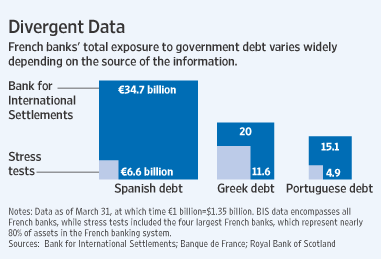

The markets are essentially telling us that they believe the stress tests were a complete joke.  From the Journal:

"LONDON—Europe's recent "stress tests" of the strength of major banks understated some lenders' holdings of potentially risky government debt, a Wall Street Journal analysis shows.

The stress tests' upbeat results—only seven banks flunked, and were deemed short of just €3.5 billion ($4.51 billion) of capital—initially soothed markets. But fears have flared up again as heavily indebted countries like Ireland and Greece continue to struggle. Among other warning signs, the costs of insuring many bank and government bonds against default in countries such as Portugal, Ireland, Greece and Italy have jumped above their pre-stress-test levels."


My Take:
 
I just have to chuckle when I read this stuff.  Just when you thought it was safe to walk outside and invest the boat springs another leak.
 
Always follow the credit markets when you are trying to figure out who is lying.  The fact that spreads have soared above their pre-crisis levels tell you all you need to know.
 
Investors Continue to Bail on the Market
 
I hope the central bankers of the world are beginning to question their "extend and pretend" strategy.  No one is buying it anymore.  Fundemental investors have completely bailed out of the stock market.
 
Bob Pisani quoted some interesting data from Tabb Group today:
 
"Who's trading stocks these days?
 
I get asked this question constantly; last Friday Larry Tabb, who runs Tabb Group, and I had a fascinating discussion about high frequency trading and the Flash Crash. Here's Larry's estimates on who is trading as a percentage of total volume on all the equity exchanges.


Who's trading?

(% of daily volume)

- High frequency trading 56%
(includes proprietary trading shops, market makers, and high-frequency trading hedge funds)

- Institutional 17%
(mutual funds, pensions, asset managers)

- Hedge funds 15%

- Retail 11%

- Other 1%"


Quick Take

Let's do a little math here folks.  The HFT's and hedge fund traders now make up 73% of the market volume.  Add in the institutional fund managers and you are now up to 90%.

The retail investor has essentially pulled an Elvis and "left the building".

The way I see it this makes the market extremely illiquid.  How can anyone be comfortable when 73% of the market trading is being done by predatory traders that are taking short term positions in an attempt to make a quick buck?

The market is going to continue and trade like a casino as long as this is the case. 

As Jim Rickards brilliantly said yesterday:

"The markets are not reflecting fundamentals, because there are no more fundamental traders. It is an accident waiting to happen."

Essentially, there is no way to consistently analyze the market when it's filled with traders that are looking to make a quick buck in a matter of seconds or hours. 

Markets are liquid when people are fundementally buying stocks for the longer term.  The flash crash proved that the current market is not liquid.  It showed us that the robots all head for the exits as soon as the market rolls over.

What happens next time when there are no individual investors left in the market to help soften the blow when the next flash crash hits?

Can you blame investors for running away from the stock market as fast as they can?

The Bottom Line

Keep an eye on the European debt crisis.  There are a lot of rumors circulating out there that a European bank might seriously be in trouble.  Bonds soared and gold closed in on new highs as fear among investors continues to rise.

Eventually something has to give here folks.  The door can no longer be shut because there are so many skeletons in the banks closets at this point.

You have to wonder if the central banks are beginning to realize that they can no longer keep this market propped up. 

The New York Times actually suggested that we let the housing market crash:

"Over the last 18 months, the administration has rolled out just about every program it could think of to prop up the ailing housing market, using tax credits, mortgage modification programs, low interest rates, government-backed loans and other assistance intended to keep values up and delinquent borrowers out of foreclosure. The goal was to stabilize the market until a resurgent economy created new households that demanded places to live.


As the economy again sputters and potential buyers flee — July housing sales sank 26 percent from July 2009 — there is a growing sense of exhaustion with government intervention. Some economists and analysts are now urging a dose of shock therapy that would greatly shift the benefits to future homeowners: Let the housing market crash."

When you start seeing articles like this from the Times you can assume we are closing in on the ending.

What that looks like is anyones guess.  One thing can be assured:  It won't be pretty. 

A few "hopes" before I end it today:

Let's hope all of the insanity finally ends with real price discovery in all areas of the markets no matter how bad they are. 

Let's hope we can take our market back from the trading robots.

Let's hope the government stops propping up housing and allows them to drop to prices where buyers can actually afford them.

Let's all just say enough is enough.

Disclosure:  No new positions taken at the time of publication.

Monday, September 6, 2010

College Ponzi Scam Exposed

I guess you have to live in Russia in order to hear the truth about our economy.

It's a shame that college students have to destroy themselves financially in order to get an education.

Twenty years from now we will be asking ourselves how we got so less competitive in the world as younger generations decide to start taking a pass on college.

Our credit bubble is becoming more and more exposed as our economic "boat" continues to take on water.

It's only a matter of time before it sinks.


Sunday, September 5, 2010

Inflation/Deflation: Does it Really Matter?

I hope everyone is having a great holiday.

I wanted to start with a little advice today.  Take 45 minutes out of your life and listen to an interview with Stoneleigh from The Automatic Earth Blog.

The most important thing that a person can do is to look at the macro economic environment when one is trying to protect their finances.  This is an issue that is stressed by Stoneleigh and it's something that I try to do as well.

What happens in the short run in the markets is essentially meaningless in today's financial world that's filled with fraud and trading robots. 

I was amazed last week at the bashing of the bears after a three day rally that was pulled off during a week where we saw incredibly light volumes due to the fact that: 

1.  Many of the big players being on vacation.
2.  Investors are petrified to get involved in stocks because they have no confidence in the market.

I saw negative press on the so called "permabears" all over the Internet on Friday as the bulls rejoiced their little run.

Folks, the reality here is we saw a 3 day 400 point rally that in the long run that means nothing in the scheme of things.  We still find ourselves a tad lower for the year on the S&P 500 despite this recent rally:


My Take:

Despite the fact that stocks have gone nowhere for the past year, the bearish camp continuously gets attacked.  I really don't get it.  I guess perhaps many Americans buy into the biased financial media that continue to pump the "recovery" story.

Day after day as the economic data gets released the media immediately focuses on the "silver linings" if the data point is bad.  Why can't they just stick to the facts and tell us theeconomic data just flat out stunk?

If the data is bad then report it.  Don't try and spin it positive.  News reporters are supposed to stick to the facts.  Our press for whatever reason doesn't see it that way.  CNBC feels they have a duty to paint a "smiley face" on every data point.  Anyone with a brain has lost all respect for networks like this.

A great example of this is the jobs report.  The focus from the media was on the 67,000 jobs created by the private sector versus the overall net losses that we saw in jobs. 

This of course is a joke:

As I have said previously, anything under 150k job growth is a total failure because that's how many jobs are needed in order to show lower unemployment.

Permabears or Realists?

In my opinion the word "permabear" needs to go away.  People with bearish views are realists at this point when you see where the economy is.  The permabulls are trying to hang on to a way of life that is financially unsustainable.

I expect to see continued attacks on the bears because the elite in this country have no desire to accept the collapse of their Ponzi scheme.  I am frightened by what they plan on doing to the sheeple as the Ponzi scheme begins to fall apart.

You can expect to see higher taxes, tougher BK laws, and less public services as the elite attempt to prevent the unraveling of this bubble.  They will fail of course but that doesn't mean they won't try.  They will make our lives miserable in the process.

Deflation/Inflation Debate

I wanted to add one point before I finish.

Stoneleigh made some great points around deflation.  She called the "printing money" inflation theory basically a form of accelerated deflation versus a classic Japanese deflationary 20 year death spiral.  In her eyes the end result is the same:  An economic collapse.

Therefore, we need to ask ourselves if the inflation/deflation debate even matters anymore.

This is an excellent piece of analysis.  The endpoint is the same in either scenario.  As Stoneleigh explains:  The only difference is the collapse happens much faster during a "hyperinflation/inflation" type event.  Perhaps hyperinflation should be renamed hyperdeflation?

I mean let's play out the hyperinflationary scenario:

The price increases that would be seen during a hyperinflationary event would be unsustainable because people would not have the money to afford anything.  Demand would therefore collapse which would then send prices lower as the economy unwinds.  So essentially this then puts us right back on the deflationary train.

The Bottom Line

The bottom line here folks is the stock market has going nowhere since the beginning of the year.

The economic data continues to accelerate to the downside.  Rallying based on "better than expected" numbers that continue to tell us that  the economy is detiorating is a fools game. 

The government is using every resource they have as they attempt to pump the markets with confidence around the so called "recovery".

All I can say is don't believe the hype:  The economy continues to be in a  freefall.  Unemployment rose on Friday and home sales remain near an all time low despite historically low mortgage rates.  U6 unemployment is now close to 17% according to Friday's number.

I hope you all continue and prepare yourselves for the financial collapse that cannot be avoided at this point.

Let's discuss how you can prepare yourself for this before I finish up:

-  Pay down as much debt as you can.
-  Raise cash.
-  Avoid large purchases that will increase your debtload.
-  Diversify your portfolios for both inflation and deflation.
-  Do not buy a house...Period.

I will end it there.

Let me close by advising you to avoid the short term moves in the market.  The pigmen on Wall St will always use any rally as a marketing tool to suck even more of the sheeple into buying stocks.

What usually happens in such scenarios is Wall St uses this opportunity to sell their stock holdings on these artificial rallies to the retail investor who is then left holding the bag.

Remember:  The rallies are artificial because the economy is not recovering.  How many times have we seen this game before in the past 10 months or so.

Look back at the last 10 years and see how buying equities has worked out for you if you had followed their advice.

You will find that you would have significantly crushed Wall St's performance if you simply bought CD's and stayed in cash.

This is why I always preach preservation of capital in a market like this.  Getting sucked into stocks has been  losers game over the past 10 years if you bought and hold. 

If you decide  to try and "trade" the markets during this period on a daily basis you also likely lost money.  The data that's available shows that 99% of people that try and daytrade the market lose money.  You never hear that side of day trading when you read the comments section of trading sites.

I know it's boring but the best option in times like these is to sit in cash and wait for the opportunities that will develop once the Ponzi scheme falls apart.

This is where the real money will be made.  Assets will be available at pennies on the dollar once the Ponzi scheme collapses ,and good stocks will offer ridiculous dividends in order to get you to invest in their companies.

Patience grasshopper patience.

Have a great holiday!